
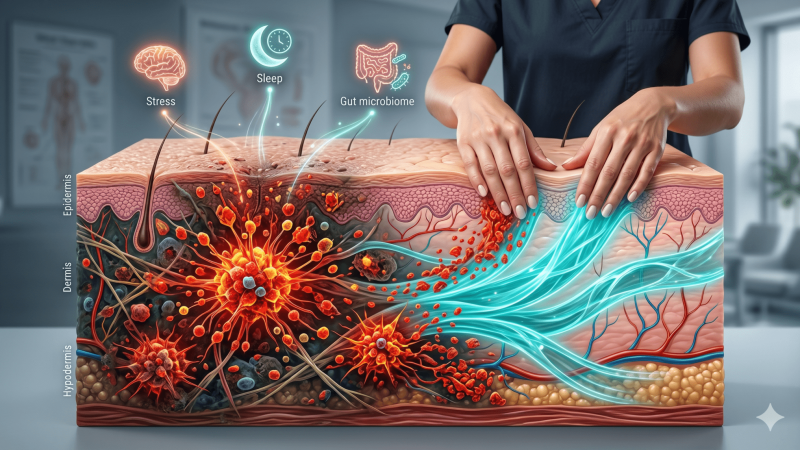
If you missed Part 1 (What is a zombie cell), here’s the short version: senescent cells, zombie cells, don’t just stop working. They actively broadcast inflammatory signals into surrounding tissue, degrading collagen, disrupting the barrier, and keeping the skin locked in a state of chronic low-grade inflammation that your best treatments can’t fully override.
That’s why results plateau. That’s why some clients never quite turn the corner, no matter what you do in the room.
But here’s the question Part 1 left open.
Where are the zombie cells coming from, and why does one client accumulate them so much faster than another?
The Boat with a Hole in It
Imagine you’re bailing water out of a boat. Good technique, solid tools, real effort — and the boat keeps filling back up.
That’s what it feels like to treat a client whose skin is continuously producing more cellular burden than the body can clear. You’re not doing anything wrong. You’re just not finding the leak.
The leak is upstream. And upstream, for most of your clients, it looks a lot like their daily life.
What’s Actually Driving the Burden
Chronic stress isn’t a lifestyle consideration. In cellular biology, sustained elevated cortisol suppresses the immune processes responsible for clearing senescent cells, increases the very inflammatory signals the zombie broadcast runs on, and measurably accelerates cellular aging. The skin on your table that reacts to everything, heals slowly, and never quite stabilizes — that’s often a stress story wearing a skin story’s clothing.
Sleep is where the skin does the repair work your treatments initiate. Collagen synthesis, mitochondrial repair, barrier restoration, and cellular debris clearance, these processes run almost entirely during deep sleep. Disrupted sleep doesn’t just leave clients tired. It leaves their tissue burdened every morning before they walk out the door.
The gut-skin axis is one of the most documented relationships in current aging research. A disrupted microbiome drives systemic inflammation that feeds directly into the inflammatory load the skin is already carrying. The client whose skin is persistently reactive despite doing everything right on the surface often has a fire burning from a different direction entirely.
And then there’s the lymphatic system, which is where your hands come back into the picture. The SASP, the zombie broadcast, generates inflammatory byproducts that need to be physically removed from tissue before the next layer of treatment can land. When the lymphatic pathway is sluggish, that debris sits in the tissue. You can apply your most sophisticated chemistry right on top of it, and the skin’s ability to receive and respond is already compromised.
Opening the lymphatic pathway isn’t a finishing touch. In the context of zombie cell science, it’s the first thing you do.
The Intake Conversation That Changes Everything
None of this requires you to practice outside your scope. It requires a slightly different intake and conversation, one that asks not just what products a client is using but how her body is functioning. Sleep. Stress load. Digestive patterns. Inflammation that moves and shifts.
You’re not diagnosing. You’re building a more complete picture of what you’re walking into.
And that picture changes the sequence, the product selection, the realistic outcomes, and the conversation you have with a client about why her skin responds the way it does.
When a client understands that her skin reflects her biology and not just her routine, she stops looking for a better product. She starts understanding why the treatment room is part of a larger conversation about her health.
That shift in understanding is where the real results begin.
What Comes Next
Once the upstream conditions are addressed and the tissue can finally receive, the question becomes: what are you applying, and what is it doing at the cellular level?