
We’ve covered a lot of ground in this series.
Previously, we explored the influence of zombie cells, the inflammatory broadcast that undermines optimal skin function, and the key upstream drivers, stress, sleep, gut, lymph, that determine treatment readiness. We also uncovered the chemistry of clearing, emphasizing that a peel’s effectiveness depends entirely on the cell environment it encounters.
With that foundation in place, we move forward to a part every esthetician will recognize: the modalities. These are often the tools we fell in love with first.
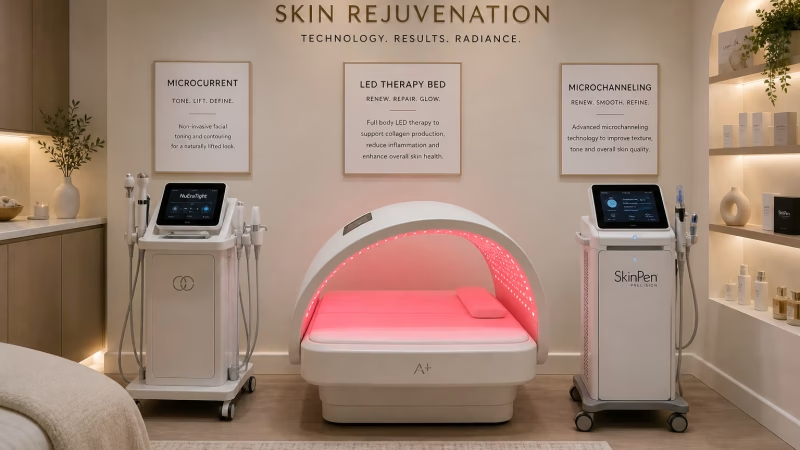
Microcurrent. Red and near-infrared LED. Microchanneling.
You probably already use at least one of these. You’ve seen what they can do. But the research on cellular senescence has something specific to say about
Every treatment is a signal to the cell. This article is about what those signals actually are.
Microcurrent: Speaking the Cell’s Own Language
Microcurrent isn’t new. It’s been in treatment rooms for decades, and the results, visible lift, improved tone, accelerated healing, have always outpaced the explanations most practitioners were given.
Here’s the cellular explanation that matters most in the context of this series: microcurrent stimulates the production of adenosine triphosphate, ATP, the energy currency every cell runs on. In a healthy cell, ATP drives protein synthesis, waste removal, membrane repair, and communication with neighboring cells. In a senescent or burdened cell, ATP production drops significantly. The cell becomes slow, quiet, and inefficient, part of why zombie cells accumulate in the first place.
When microcurrent is applied to tissue that has been regulated and cleared upstream, it delivers an electrical signal to cells that are metabolically primed to respond. Fibroblasts that are no longer suppressed by the SASP broadcast can actually act on the signal. Collagen synthesis accelerates. Cellular communication, the kind that coordinates repair across tissue, improves.
Applied to congested, burdened tissue, microcurrent still delivers energy. But the cells receiving that signal are operating under an inflammatory load that suppresses the very pathways the current is trying to activate. You’re essentially sending a message to a receiver that can’t fully process it.
The protocol hasn’t changed. The environment it lands in changes everything.
Red and Near-Infrared LED: Reaching the Mitochondria
Photobiomodulation, the mechanism behind red and near-infrared LED, is one of the most rigorously studied modalities in the field right now, and what the research is surfacing goes well beyond surface-level results.
The primary target of red and near-infrared light isn’t the skin surface. It’s the mitochondria, specifically a protein inside them called cytochrome c oxidase. When light in the 630–850 nanometer range reaches this protein, it triggers a cascade: nitric oxide, which inhibits cellular respiration under stress, is released. Mitochondrial function improves. ATP production increases. And critically for the zombie cell conversation, the cell’s ability to regulate its own inflammatory response is restored.
Multiple peer-reviewed studies, including research published in
There’s also evidence that consistent photobiomodulation supports the body’s own clearance of senescent cells — not by replacing senolytics, but by creating a cellular environment in which normal apoptotic pathways function more efficiently. The cleanup system starts working better.
In a skin that has been cleared and regulated before the LED series begins, these effects compound. In a skin that is still carrying a significant cellular burden, the light reaches tissue that is working against itself, attempting to restore mitochondrial balance while the SASP is simultaneously driving dysfunction in the same cells.
LED is powerful. Sequence makes it more powerful still.
Microchanneling: Sending a Signal the Skin Knows How to Read
Of the three modalities in this stack, microchanneling is the one most often described in terms of its mechanical action, the channels, the depth, the controlled micro-injury. And those things matter. But the cellular story behind microchanneling is where the zombie cell framework becomes most immediately practical.
When microchannels are created in the skin, the body reads the signal as a wound. Not a traumatic wound, a precise, controlled one. And the response is a coordinated healing cascade: platelet-derived growth factors, keratinocyte activation, fibroblast migration, and collagen synthesis. The skin mobilizes its repair system.
Here’s what that means in the context of senescent cells: the repair system that microchanneling activates is the same system that zombie cells have been suppressing. The SASP disrupts growth factor signaling. It blunts the fibroblast response. It interferes with the coordinated cellular communication that makes repair possible. When microchanneling is performed on tissue that is still carrying a high senescent cell burden, you’re generating a repair signal into an environment that is actively working to suppress repair.
But microchanneling performed after the tissue has been regulated, after the lymph has been opened, the inflammatory load addressed, and the cellular environment quieted, delivers that signal into the tissue that can actually execute the response. Growth factors land on receptors that are no longer blocked. Fibroblasts migrate. The collagen cascade is complete.
The channels are the same. The results are not.
The Stack in Sequence
What makes these three modalities a
Microcurrent restores cellular energy and improves communication between cells that repair depends on. LED quiets the SASP-driven inflammation and supports mitochondrial function so cells can act on that energy. Microchanneling initiates the growth factor cascade into tissue that is finally in a state to respond.
Each one amplifies what the others started. And all three are doing work that is fundamentally different from what they would be doing in a burdened, unconsidered skin environment.
This is the framework the series has been building toward: Regulate. Clear. Rebuild. Restore. Not as marketing language. As a biological sequence that determines whether the signals you’re sending can actually be received.
What Changes in the Room
Understanding the rebuild and restore stack doesn’t require new tools. It requires a new lens on the tools you already have.
It means asking whether the tissue is ready to receive microcurrent before you begin the series, not just whether the client has contraindications, but whether the upstream conditions have been addressed. It means thinking about LED not as a finishing touch or a calming add-on, but as a mitochondrial and SASP-targeted modality that belongs in the foundation of a cellular aging protocol. It means treating microchanneling as a growth factor event, and sequencing everything before it to give that event the best possible environment to land in.
It changes the intake. It changes the sequence. It changes the conversation you have with clients about why the work you’re doing is different from what they’ve tried before.
And eventually, it changes the results, not because you’ve found better tools, but because you’ve learned how to use the ones you already have at the right time, in the right order, in tissue that was prepared to respond.
The End of the Series. Not the End of the Conversation.
This is where the four-part framework closes.
Zombie cells and the SASP broadcast. Upstream drivers and the congested foundation. The chemistry of clearing and the senolytic opportunity. The rebuild and restore stack.
It’s a complete loop. Each phase sets up the next. And the whole thing starts with a single shift in perspective: from thinking about what to apply, to thinking about whether the environment is ready to receive it.
The skin has always been communicating. Your treatments have always been sending signals.
Now you know more about what those signals are doing, and how to make sure the cell is in a state to hear them.