
Compassion is the category at The Skin Games that is judged on generosity, not just skill, which should come as a relief if you’ve been worried your technique has to be flawless, but it’s also more demanding than it sounds, because generosity only scores when you can show it, document it, and explain it to a panel. If you want the full season first, start with Everything You Need to Know About The Skin Games 2026-27 Season, and then come back here, because in this category what you do for other people is the entry.
What the category honors
TSG describes Compassion as honoring “beauty professionals who are making a difference through acts of compassion and service.” Entrants can show “all the great things you and/or your business are doing to make the world a better place,” and the category is open to beauty professionals worldwide, so this is not limited to one license type or one kind of service. If you do pro-bono treatments, community outreach, or any other work that serves people who wouldn’t otherwise get it, that work is the material you’re entering with.
Two ways to build an entry
There are two ways to build an entry, and which one you pick decides how much paperwork you need.
In the first, you play on behalf of a nonprofit. If you win, the prize money goes directly to that organization, and for this we would ask for the nonprofit’s name, address, and proof of nonprofit status, plus contact details for a representative, and how the prize funds would be used inside the organization. TSG also requires documentation on how the funds are used afterward, to maintain “transparency and integrity.”
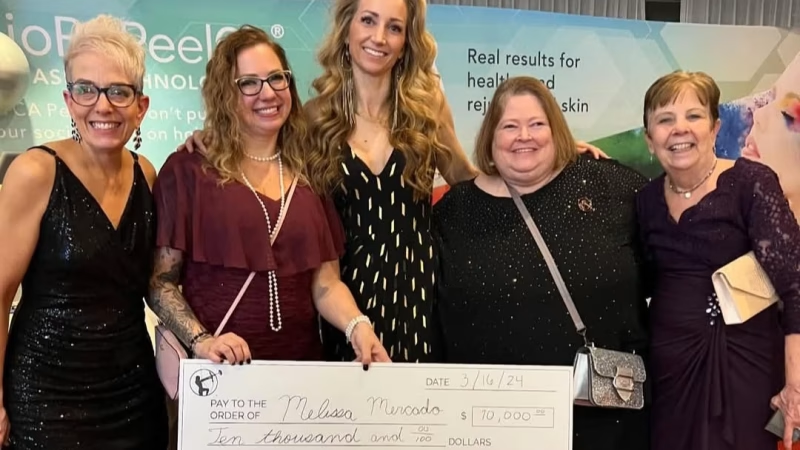
In the second, you submit acts of compassion or service that you do on your own, without payment, and the category page is clear that “you don’t need to work directly with a nonprofit to enter!” TSG’s September scoring guide describes prizes of up to $10,000 and $5,000 for entries on behalf of a registered nonprofit, and $3,500 for self-funded personal give-back entries. However, the prize money is usually decided by how much we can raise in contributions and auctions through the year for this category.
What you submit
Every entry is two videos, each up to three minutes. The first is about you: your name, role, and location, what your business does, your nonprofit partner if you have one, and your why. The second is about the act itself, covering what happened, when, where, and who was involved, with clips or photos of you actively taking part, who benefits, a testimonial, and how the prize funds would be used. Alongside the videos you send a completed questionnaire and, if you’re playing for a nonprofit, the organization’s information.
TSG says points are deducted for incomplete videos, and the reason is simple: the panel can only score what it can see. So you want to make sure every item on that list is answered somewhere on screen, not left for the judges to assume.
Who judges it
The 2026 Compassion panel included four people, and each one comes at the category from a different direction. Brandie Humphrey founded The Golden Glow Project, which connects spa professionals with assisted living facilities and cancer centers to provide wellness days. Traci Daly-Smith founded A New Daily Beginning in Atlanta, a nonprofit that provides free and low-cost integrative care for cancer survivors. Holly Brown, whom TSG calls the “Mother Tree” of the category, founded Looking and Feeling Fab and specializes in treating the skin side effects of cancer treatment. Steve McGee is the CEO of NeoGenesis, and he sees his role as serving the estheticians who serve the clients.
TSG’s panel write-up says this category is unusual because “the judges don’t just score; they mentor.” Their advice is worth reading before you film anything. Brandie Humphrey: “Give everything away. When you give more, you get more back.” Holly Brown: “It’s okay to reach out for help. Knowledge is only good if you share it.” Steve McGee: “If you do good, you’ll do well. Let people help you where you are vulnerable.” And Traci Daly-Smith, on nonprofits: “Nonprofits can’t make it without the kind people doing the hard work behind the scenes.” The full conversation is in Insights from the 2026 Compassion & Face Massage Panels.
Finalists and the live interview
The category is limited to 10 finalists, chosen by the panel, and finalists are interviewed live during the show. That means the two videos get you in the door, and your ability to talk about the work in person decides the rest. The 2026-27 season ends with the live event on September 9 to 11, 2027, in Dallas, Texas. If you want to see who has done it before, the category page lists the 2024-25 winners: Leigh Schincarial, Ceven Loochi, Irini Sevdalis, and Genice Gonzales.
How to get ready
Start with the second video, because it’s the harder one to fake and the one that takes the longest to collect. Gather the clips or photos of you actually taking part, ask the person or organization you served for a short testimonial, and work out in plain words how you’d use the prize funds if you won. If you’re playing for a nonprofit, ask for the proof of nonprofit status early, since that’s a document someone else has to send you.
None of this means you need a large charity project. The category page doesn’t list a minimum scale, only that you show what you did, who it helped, and why you did it. If your work is small and consistent, the job is to make it visible.
So the category really comes down to this: could someone watch six minutes of footage and understand what you did, who it helped, and why you chose to do it? If that already describes the work you do, Register for Compassion.