
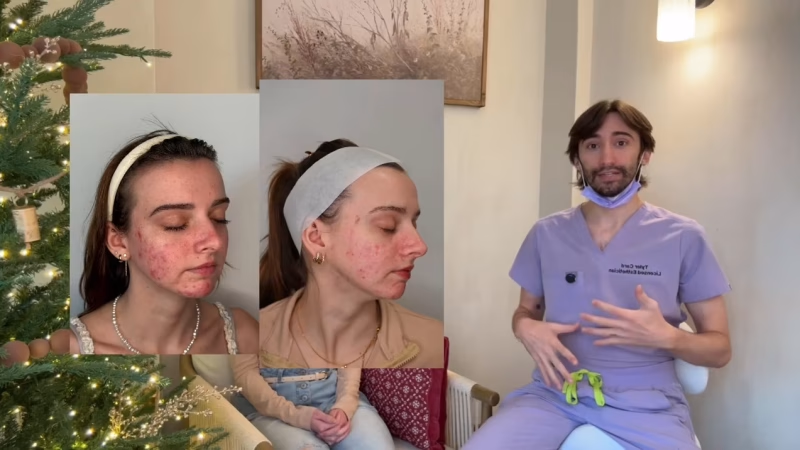
A strong compromised-skin case file shows two things: the visible progress, and how the client tolerated the care. It also explains why you made each decision along the way. Three TSG judges, each with a different angle, break down what that looks like. Anastasiia Huk covers the records behind an acne case, Aggie Singh explains why the skin’s environment matters as much as the breakout, and Kelly Wolcott, TSG’s Director of Judges, shows how to tell the story behind your care. If you’re building a case for this season, start with Everything You Need to Know About The Skin Games 2026-27 Season.
Anastasiia Huk: the records that explain your decisions
Anastasiia is a licensed esthetician, acne specialist, educator, and author, and the creator of the Acne Balance Method.
When I document an acne case, which is very often a compromised-skin case too, I want to understand the visible progress and how the client tolerated the care plan. Photographs show part of the story. A clear record of home care, skin responses, and protocol adjustments shows the rest, and it explains my decisions.
Review the complete home routine. Before I build a care plan, I find out what the client is already using, how often they apply each product, and whether they get dryness, tightness, peeling, or discomfort. That’s the context for every next step.
Make skin tolerance part of the plan. Common acne ingredients can cause dryness and irritation, so moisturizing support deserves as much attention as the actives. I look at the client’s skin response when I plan how often we do cosmetic care and how fast we progress.
Document the reasoning behind adjustments. A useful case file says what changed, when it changed, and why. Record the products used, how often they were applied, the professional treatments, any reactions the client reported, and every adjustment. If the client is also getting medical treatment, write that down and coordinate appropriately, without changing what’s been prescribed.
Use consistent photographs. Keep the lighting, angles, distance, and facial positioning as close to the same as you can. Date every photo, and note any difference in conditions that could affect the comparison.
Record what happens between appointments. Ask clients how they actually use their products and what makes the routine hard to follow. Write down missed applications, discomfort, and misunderstandings. They help explain the results, and they give you something to talk about at the next visit.
Include maintenance and referral decisions. A complete record describes the follow-up plan and says when you recommend a medical evaluation. Knowing where esthetic care stops is part of professional decision-making.
During an acne consultation, I ask the client to walk me through a typical evening routine: which products, in what order, how often, and how their skin feels afterward. The routine on a consultation form often needs clarifying. These questions tell me whether my instructions are clear and manageable. I then write down the agreed routine and review it at every follow-up. That is a core part of my Acne Balance Method: connecting professional care with home care, monitoring skin tolerance, and supporting consistency.
Here’s a case that shows it. A client came to me with acne, dryness, and a compromised skin barrier after a peel done by another professional. I worried that bringing in acne-focused actives right away would irritate her skin further. Following my Acne Balance Method, we started with barrier repair. Once her skin tolerated more, we gradually added mandelic acid and benzoyl peroxide, and I checked her skin’s response every four weeks before increasing strength. In the studio, she had facial cleansing with extractions, enzyme peels, and LED therapy, adapted to how her skin was handling things. After six months, we saw roughly a 90% reduction in acne. [[VERIFY: Anastasiia, confirm the 90% figure is documented in the client’s file, that you have the client’s written consent to share it, and whether to add “individual results vary”]]
That case is why I put barrier support and slow, monitored progression at the center of my approach. My advice to competitors: help the reviewer understand your decisions. Alongside your before-and-after photographs, give a clear timeline of the starting point, the care plan, the client’s response, and the reason for any change.
Aggie Singh: look at the environment, not only the breakout
Aggie is a cosmetologist who specializes in complex skin conditions, including compromised barrier, acne, melasma, and rosacea, and was named Aesthetician of the Year at The Skin Games 2023/24.
One case from my practice involved a barber experiencing persistent inflammatory breakouts and a compromised skin barrier. Daily shaving with foaming gels, harsh cleansers containing multiple surfactants, repeated antibiotic use, and constant exposure to heat from hairdryers were contributing factors.
Rather than continuing to aggressively target the breakouts, we focused on restoring barrier function, introducing gentler skincare, and supporting both skin and gut health. As the skin became less irritated and its condition improved, the inflammatory breakouts gradually began to settle. [[VERIFY: Aggie, confirm you want “gut health” and the antibiotic detail in a public TSG post]]
The lesson? Sometimes we focus so heavily on eliminating bacteria that we overlook the environment they live in. Restoring balance can be just as important as targeting the breakout itself.
So when I review a case file, I look for evidence that the esthetician assessed the whole skin environment: barrier integrity, dehydration, irritation, sebum production, follicular congestion, and the client’s routine. I also want to see that they supported the barrier with gentle cleansing, appropriate moisturizing, and carefully chosen actives. And I want them to separate barrier impairment from acne itself. A damaged barrier can coexist with acne and make irritation worse, but barrier damage alone doesn’t explain how acne develops. Treat the individual, not just the visible lesion. Hormones, lifestyle, product use, and the skin’s tolerance all belong in the picture.
The question I’d like every competitor to ask: are we treating the bacteria, or are we overlooking the environment it lives in? Healthy skin is not sterile skin. Sometimes the answer to problematic skin is not to remove more, but to understand more.
Kelly Wolcott: a strong case file tells the story behind the care
Kelly is TSG’s Director of Judges, a licensed esthetician and CIDESCO Diplomat with more than 25 years in esthetics.
When skin is compromised, knowing when to pause can be just as important as knowing how to proceed. A strong case file helps the reader understand both decisions.
Think of your documentation as the story of your professional reasoning. What did you observe? What did your client share? How did that information shape your plan?
Start with a clear picture of the client’s skin and concerns, relevant history, and current home care. Describe what you observed without turning an observation into a diagnosis. Explain your goals and how you decided what was appropriate within your scope of practice, including when a referral was needed.
Then connect your choices to that starting point. Name your products. Explain the relevant ingredients and why you chose them. If you used a modality, explain its purpose and why it suited this client. If you chose to leave something out, that reasoning belongs in the story, too.
Consistent photographs, dated treatment notes, client feedback, and documented home-care changes show what happened over time. Include the adjustments and the observations that prompted them. Comfort, tolerance, and the client’s experience deserve attention alongside visible changes.
Within the TSG Community, sharing this reasoning gives us a chance to learn from one another. Careful documentation also holds us accountable to what actually happened, including progress that was slower or less straightforward than expected.
This week, review one of your case files and ask: could another professional understand why I made these decisions, or only see a list of what I used?
That difference can make your documentation useful long after the case study ends.
Game On! Kelly
For how judges read every category, A Season-by-Season Scoring Guide on What TSG Judges Are Really Looking For is the next read.