
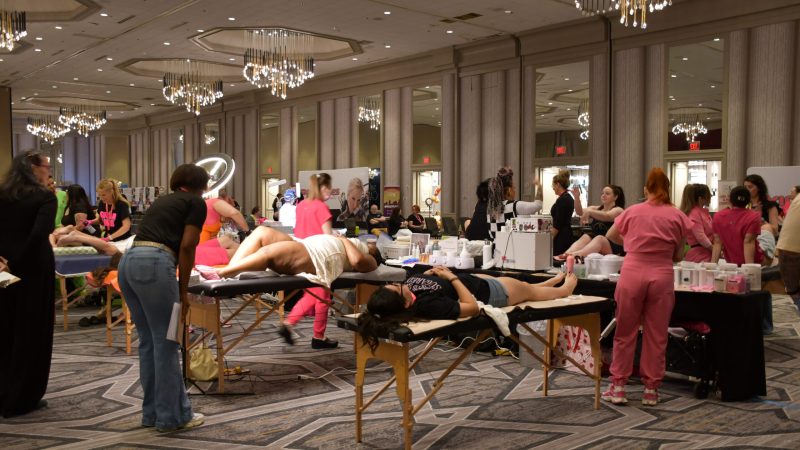
Inside the Waxing category
Jessica Young has been a licensed esthetician for 29 years, she’s built out of Mobile, Alabama, and in an industry full of people chasing the newest technique, she’s the one everyone points to for the Horseshoe Brazilian method, because she actually mentors other waxers in it directly rather than keeping it to herself. And when you ask her where competitors actually fall short, she doesn’t say technique or speed, she says something simpler and harder to fix: not being open to other techniques. A lot of estheticians, she’ll tell you, were never even taught Brazilian waxing in school in the first place, so the ones who plateau aren’t the ones who lack skill, they’re the ones who found one method that worked and stopped looking for a second.
Tara Whitaker judges the same category with a two-time #1 Brazilian wax artist title behind her and a past Waxer of the Year award, and she’s blunt about the order things have to happen in: you have to know how to lay your wax, hold the skin, apply it properly, remove it properly, before speed is even allowed into the conversation. She’s also pushing something bigger than technique, she wants the profession to rename itself: “cerologist,” pulled from the same root as wax, because “waxer” undersells what the job actually requires once you’ve mastered it.
Julio runs his own spa in Chicago, twelve years in that location and roughly twenty-five years licensed overall, and he specializes in men’s hair removal, which means he’s spent a long time thinking about how to keep a service both fast and comfortable without stacking extra cost onto the client. His answer isn’t a product, it’s pacing: he talks clients through the process in real time, uses their breathing to time the pulls, and gets the speed from the rhythm rather than from rushing.
And then there’s Tori Hylton, 17 years licensed and co-owner of a barber and cosmetology apprenticeship program, who put the sharpest line of the whole panel on quality versus speed: before somebody makes speed a priority, they need to make efficiency a priority, and she doesn’t care if it takes you 30 minutes, just do it right. All four of them, without comparing notes, landed on the same failure pattern: competitors who chase speed before the fundamentals are automatic end up losing the points that actually matter, not gaining them.
Client education wasn’t a side note on this panel, it came up again and again, unprompted. Here’s Jessica’s version of it: the better you can educate your client, the more likely they are to come back, and that makes it your responsibility as a professional, not an optional extra. Which means the scoring here isn’t only asking whether the hair came out clean, it’s asking whether you left the client actually knowing how to take care of the results.
Inside the Sugaring category
Amber Franklin has been sugaring for 20 years, she’s affiliated with Sugar of the Nile, and she teaches at several esthetics schools across Washington state, and she makes the clearest technical case for the category that anyone on the panel offered: sugar paste goes on near body temperature, so there’s no heat spike to tell the body it’s being injured, and that’s the actual, physiological reason sugaring clients report less irritation than they do with hot wax. Not a marketing line. A mechanism.
Jarratt Haviland co-owns Ke Kō with her husband Mike, and before she ever touched a treatment room, she spent years working as a research scientist, which is probably why she talks about sugaring in terms of formulation as much as feel. She founded Sugar & Bronze roughly a decade ago, one of the first sugaring practices in Louisiana, and these days she’s out of the treatment room entirely, focused on education and product development instead. Her whole philosophy centers on what she calls the client who will do nothing, meaning: build the one product that person will actually use, every time, without having to be convinced. That’s what her Aloha serum is built for, moisturizing and enzymatic exfoliation combined into a single step, because asking a client for two habits when you can only get one out of them is how home care programs fail.
Dalia Wagley has the longest history with this category of anyone on the panel, 18 years sugaring, and she competed as a Skin Games sugarista herself back when sugaring and waxing were still one combined competition, which means she’s watched this category grow from the inside. Her advice to anyone on the fence about adding the skill is short: you have to learn to earn. Rashida Loharsingh, who founded Caribbean Candy Professional Sugaring and trained in chemistry and cosmetic formulation, makes the business case even more directly: because a sugarist reuses the same ball of paste through an entire service instead of burning through sticks and strips, learning exactly how one brand’s paste behaves translates straight into lower overhead, and in her words, you’re going to make more money.
What separates good from great, in both categories
Ask the sugaring judges directly what divides a good competitor from a great one, and they converge on the same idea from three different angles. Amber’s version: technique that adjusts to the client’s comfort in real time, without ever letting the actual result slip. Jarratt’s version, more personal: it’s all about where your heart is, whether you’re a heart of service or a heart of self. And Dalia’s version is the one that’s hardest to argue with, because it’s the most honest: I can teach anyone to sugar, I can’t teach someone to care about people.
If you’re getting ready to compete in either category this season, that’s worth sitting with, because the judges aren’t only scoring whether the hair comes out clean. They’re watching whether you can explain your technique choices out loud, whether you’ve actually educated your client on aftercare, and whether the person in your chair looks comfortable the whole way through, not just tolerant of what’s happening to them.
How to prepare if you’re entering
Get the fundamentals automatic before you let yourself compete on speed, in either category, because that order doesn’t reverse once you’re live in front of judges. If live competition format is new to you generally, Your First Skin Games walks through what to expect the first time you’re judged in person rather than through a submitted case study. And if you want the full picture of what judges across every category are actually watching for, not just these two, A Season-by-Season Scoring Guide on What TSG Judges Are Really Looking For covers the throughline across all eleven.
Ready to compete?
Every competition path, Waxing and Sugaring included, is covered in the full season guide, or go straight to Register if you already know this is your category.